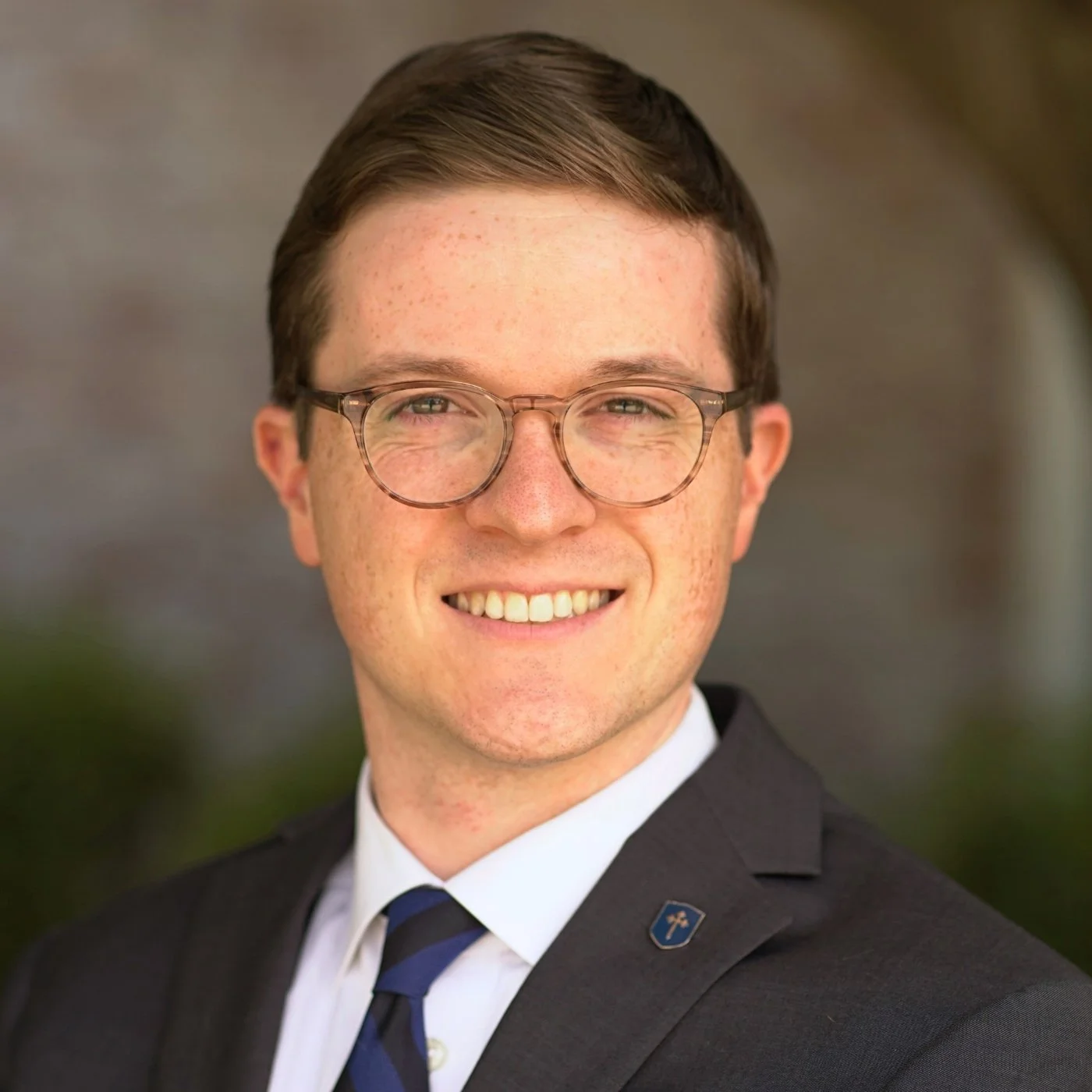
The Gospel in Hard Places: Rev. Doug Shepherd (MDiv ‘03)
If you ask Rev. Doug Shepherd what makes church planting and ministry in Lviv, Ukraine, different from doing it in the United States, and he'll likely say that it’s everything—and nothing. Doug and his wife, Masha, both Covenant Seminary graduates, have been serving in Lviv with since 2006. Doug is the team leader for a church planting initiative through the Evangelical Presbyterian Church of Ukraine.
Like many international missionaries, Doug’s story didn’t begin in the country where he now serves. He grew up in Texas, attending a PCA church with his family. That's where God first started to cultivate in Doug’s heart a desire to work in international missions: “The Lord was gracious to me as a covenant child, and I was really convinced of the gospel more deeply when I was around 20. And that’s when I started considering that if people didn’t know the gospel in other places and some people weren’t willing to go, then I was more than willing to go.â€
Doug considered different avenues for international ministry and went on a number of short-term trips, including one with MTW in Sweden. He rounded out his senior year in college with inner city work in Texas before applying to MTW upon graduation. Doug’s first opportunity to serve in Ukraine came rather unexpectedly: “I said, ‘Look, I’m young, single, have no debt, and I know Spanish.’ And they said, ‘How about Ukraine?’â€
It was the early 1990s, and the iron curtain had just fallen in eastern Europe. The PCA, alongside other evangelical organizations, was sending workers at the request of the Commonwealth of Independent States to teach a morals and ethics curriculum for their teachers: “I signed up to go for what I thought would be 10 months. I did my job, but I had a lot of young people and college students gathering around to talk about the Bible. At the same time, a church planting team was coming in as a follow-up to this work. I was more interested in something enduring, so I jumped on the MTW church planting team.â€
The MTW team felt that Doug had a gifting for university ministry and allowed him to attend Reformed University Fellowship (RUF) staff training as a “back door†way to be prepared and equipped for the kind of work he would be doing. This special opportunity helped confirm his call to minister to college students, and the principles and philosophy of ministry he imbibed from RUF translated easily to a cross-cultural context.
During this time, the Lord also began to nudge Doug toward theological education, and—even more specifically—toward Covenant Seminary. “The guys I noticed in that room knew their stuff, but they were also gracious,†he says. “Knowing the truth is one thing. Holding and manifesting it in a way that is consistent with the gospel is actually what we’re called to. These guys stuck out to me, and I found out they were at Covenant. This was what I needed.â€
Doug went back to Ukraine after RUF training to work with college students, and the Lord richly blessed the ministry. People were coming to faith. Eventually, through the work of MTW and other ministries in the region, the Ukrainian Presbyterian denomination was formed. But Doug couldn’t shake the feeling that he had all but exhausted the ministry tools he had to work with. He was sure God was leading him to long-term international missions, but he also knew he needed an education that would sustain him for whole-life ministry.
“Covenant was where I was going to go,†Doug decided. “So, I trained a girl to be my replacement before I left. That girl ended up being my wife later, by the way.†Even after arriving as a student at Covenant, Doug was traveling back to Ukraine for internships. He asked Masha to marry him, and the couple finished their season of work in Ukraine, then both started seminary in St. Louis around 2000.
“Our needs were to be equipped and grounded for a lifelong ministry, and Covenant confirmed this,†Doug recalls. “There was intentional community. And the thing that struck us most was that the professors were not primarily interested in being academicians, but practitioners who were academic. They knew their stuff, that knowledge manifested itself into pastorally caring for people wherever they were. And how they taught was a model of what I needed on how to articulate the gospel in a way that was gracious, patient, and clear. If anyone asks us about Covenant—even to this day—that’s the main thing we want them to know.â€
One of the most important practices for a Christian in the mission field is hospitality. Doug speaks of how the “hospitality value†of Covenant Seminary was impressed upon him during his time as a student. “Whether it was being in Dr. Hans Bayer’s home or one of the other professors’ homes—with them being willing to be accessible and in the community rather than above the community—those personal interactions were foundational. That’s just gospel ministry. That allowed us an extra window into their lives that supported the academics. The professors, in these personal interactions, were modeling how to minister—how to care for people.â€
Masha graduated with an degree in 2002, and Doug with an in 2003. Doug would also complete a ThM at Fuller Theological Seminary before the couple considered where the Lord was calling them next. A further need in Ukraine seemed like a natural fit. Doug agreed to lead the church planting team in Lviv, the cultural and intellectual center of western Ukrain, helping to multiply churches and impact the next generation of missionaries in the region. Besides coordinating children’s education, Masha uses her training to lead a multi-generational group of women in the church.
Today, the logistics of ministry in Ukraine have changed due to the realities of war. For Doug, even amid violence and trauma, the ability to rightly handle the Word of truth has made all the difference: “If you don’t know how to handle the truth well and contextualize Scripture with respect to its first hearers and to your cultural context, then you’ve really been replaced by Google. There’s just no need for you.â€
Lviv has been significantly affected by the war, and the exegetical, cultural, and contextual skillsets Doug and Masha learned at Covenant are constantly at play: “In the midst of all this trauma, it's about coming together and saying, ‘Okay, what’s happening here in 1 Samuel?’ or ‘What is being said here in 2 Peter?’ And how were the first hearers suffering, struggling, or being persecuted?’ And then bringing it back to, ‘Is Christ here? Does he make promises? Is the gospel real? And who are you in him?’â€
The Shepherds’ ministry in Ukraine certainly looks different than it did some years ago. Even so, the foundation for that ministry has not changed: “There’s no place that the Lord could call us where we wouldn’t be equipped with what Covenant gave us. That doesn’t mean there wouldn’t be hardship or that we wouldn’t have something to learn. But we’ve been put in the most vanilla situations where I do Bible studies and preach, and also in the most horrific, traumatic situations that are some of the darkest—and God’s promises have not wavered. The gospel truth is there. We feel Covenant prepared us to be in those places.â€
Note: This article first appeared in the fall 2025 edition of Covenant magazine. Get your copy or subscribe to Covenant here.